


Our tech team has launched updates to The Nest today. As a result of these updates, members of the Nest Community will need to change their password in order to continue participating in the community. In addition, The Nest community member's avatars will be replaced with generic default avatars. If you wish to revert to your original avatar, you will need to re-upload it via The Nest.
If you have questions about this, please email help@theknot.com.
Thank you.
Note: This only affects The Nest's community members and will not affect members on The Bump or The Knot.
CDC: US autism rate up 78% in the last decade


CDC: U.S. kids with autism up 78% in past decade
- One in 88 U.S. kids thought to be autistic, CDC says; for boys it's 1 in 54
- Why? Better, broader diagnosis, better awareness, and "50% of 'We don't know," expert says.
- Advocate: There is an epidemic of autism in the United States.
- Autistic teen Frankie Sanders shows benefits of early detection
(CNN) -- The number of children with autism in the United States continues to rise, according to a new report released Thursday by the Centers for Disease Control and Prevention. The latest data estimate that 1 in 88 American children has some form of autism spectrum disorder. That's a 78% increase compared to a decade ago, according to the report.
Since 2000, the CDC has based its autism estimates on surveillance reports from its Autism and Developmental Disabilities Monitoring Network. Every two years, researchers count how many 8-year-olds have autism in about a dozen communities across the nation. (The number of sites ranges from six to 14 over the years, depending on the available funding in a given year.)
In 2000 and 2002, the autism estimate was about 1 in 150 children. Two years later 1 in 125 8-year-olds had autism. In 2006, the number was 1 in 110, and the newest data -- from 2008 -- suggests 1 in 88 children have autism.
U.S. kids and autismOverall: 1 in 88 U.S. kids have autism; up 78% from 2002
Boys: 1 in 54; up 82% from 2002
Girls: 1 in 252; up 63% from 2002
Non-Hispanic white children: 12 in 1,000; up 70% from 2002
Non-Hispanic black children: 10.2 in 1,000; up 91% from 2002
Hispanic children: 7.9 in 1,000; up 110% from 2002
Symptoms typically apparent before age 3
Source: Centers for Disease Control and Prevention
Boys with autism continue to outnumber girls 5-to-1, according to the CDC report. It estimates that 1 in 54 boys in the United States have autism.
Mark Roithmayr, president of the advocacy group Autism Speaks, says more children are being diagnosed with autism because of "better diagnosis, broader diagnosis, better awareness, and roughly 50% of 'We don't know.'"
He said the numbers show there is an epidemic of autism in the United States.
Early recognition of signs of autism -- a neurodevelopment disorder that leads to impaired language, communication and social skills -- is vital because it can lead to early intervention, says Dr. Gary Goldstein, an autism specialist and president of the Kennedy Krieger Institute in Baltimore.
"There have been studies -- double-blinded studies -- to show that behavioral early intervention changes the outcome for children," Goldstein says.
Roy Sanders and Charlie Bailey sensed something was wrong with their son Frankie Sanders when he was 9 months old.
"Our pediatrician at the time who was a friend of ours tried to tell us that we were being too cautious, we were being too anxious," Sanders says.
Frankie's pediatrician thought his parents were seeing developmental delays that weren't really there. But Frankie wasn't talking, Sanders says. "He didn't have speech; he didn't have any communication skills at all. He didn't point. He would flap quite a bit. He would stare at fans; he would stare at lights; he would become frantic if he didn't have a Thomas the [Tank] Engine because he was obsessed with Thomas the [Tank] Engine."
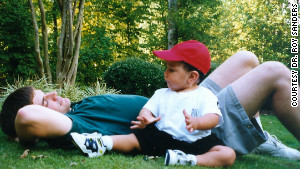
His parents kept pushing, and Frankie, now a ninth-grade nose guard and defensive guard for the Decatur Bulldogs football team in Decatur, Georgia, was diagnosed with autism when he was 15 months old.
iReport: Have a child with autism? Sign up to participate in a project with CNN.
"Early detection is associated with better outcomes," says CDC Director Dr. Thomas Frieden. "The earlier kids are detected, the earlier they could get services, and the less impairment they'll have on their learning and in their lives on a long-term basis is our best understanding."
The CDC is working with the Academy of American Pediatrics to recommend that children get screened for autism at ages 18 months and 24 months, Frieden says.
CDC: What you should know about autism
However, according to the CDC report, most children were diagnosed between ages 4 and 5, when a child's brain is already more developed and harder to change.
"Doctors are getting better at diagnosing autism; communities are getting much better at [providing] services to children with autism, and CDC scientists are getting much better at tracking which kids in the communities we're studying have autism," Frieden says.
"How much of that increase is a result of better tracking and how much of it is a result of an actual increase, we still don't know. We know more about autism today than we have ever known," he says, "but there is still so much we don't know and wish that we knew."
http://us.cnn.com/2012/03/29/health/autism/index.html?hpt=hp_t1
Those are some terrifying numbers... one boy in fifty!... and I can't imagine that all of it is more / better diagnosis. Something is going on here.


I am the 99%.
Re: CDC: US autism rate up 78% in the last decade
This made me giggle so hard. lol
Click me, click me!
This is all I could think about while reading this article. Of course diagnosis rates have skyrocketed, but that does not mean that there are actually more children with autism. Just more children with an actual diagnosis.
Well, duh, it's because of vaccinations.
But yeah about Aspergers. Autism used to be Rain Man. Now it's people who keep count of the number of red cars they pass on the high way and don't know how to end a conversation with an acquaintance.
Given the changes in diagnostic assessments and criteria over the last 10 years, the increased numbers of kids being diagnosed doesn't surprise me in the least...so many kids who when I was in elementary would have been seen as quirky or odd are being diagnosed as having an autism spectrum disorder nowadays. Is it an epidemic, though? No, I don't think so.
This is where I am. My older son had similar issues to the boy described in the article. No language/communication skills even as late as 17 months. No pointing. Some other kind of strange little things.
We put him in ECI for help with language skills. We did that for about a year. Now he's fine. Totally on track developmentally. In our area I'm told it can be more difficult to get an autism diagnosis for toddlers. Reading this just makes me wonder if we could have gotten that diagnosis somewhere else, if we had wanted it.
No and I think there is a certain hysteria surrounding the idea of autism. When my son started school this year, he was a little shy and hesitant to go up and play with the other kids or to talk to the teachers. So the head teacher strongly encouraged me to have him evaluated, even though she admits that since then he has made enormous progress and is basically a different kid in her class. I understand that it's better to catch these things on the early side, but really what happened to being shy or a little reserved?? Are these no longer valid personality traits in our society?
Anyway we did have him evaluated (it took NINE MONTHS to get in to see a developmental pediatrician probably because of all the other parents being advised that it's "better to be safe than sorry") and the guy basically looked at us like we have two heads. Long story short, he's a totally normal kid and it's fine to be shy.
What if maybe this has something to do with the shift our society has taken over the last 30 years toward more fear/panic/helicopter parenting?
So PP says it took 9 months to get her son in to be evaluated- isn't it reasonable that maybe some of these parents are so convinced that something is wrong with their shy or introverted kid that they are visiting numerous doctors until they get the diagnosis they want?
Today's parents are the "rub some dirt on that cut and keep playing type". They want to solve all their kids problems and if they feel even a little twinge that maybe their kid is off a bit socially, they make it a crusade to find a cause.
Just a theory to throw in the pot.
Interesting. Though if this was a red flag when I was your son's age, I would have been diagnosed on the spectrum.
I'm not sure I understand why we pathologize personality quirks. Without a doubt there are children who are diagnosed on the spectrum that should be, but I think there are a lot that really shouldn't be.
I eventually came out of my shell but not until after college. And some therapy.
Our pedi had us take DS1 to a pediatric neurologist for an eval. I felt it was unnecessary but he said he really wanted us to cover all the bases. It took almost 6 months to get in and we got the same reaction.
I don't think your theory is completely off base. I can't tell you how many kids and families my colleagues and I have worked with who have done something similar, because honestly, an autism spectrum diagnosis opens up a ton of options re: therapies, funding for those therapies/schools/etc, and other things that aren't available to them without that diagnosis in place. So a parent may think their kid is delayed in some way, or even have some sort of diagnosis of a delay, and want every service they can get their hands on for their child so they seek out a diagnosis from anyone that will give them what they want. I completely understand wanting every service available for your child IF THEY NEED IT but the problem that we're running into now is that there can be more kids qualifying for services b/c someone gave them an autism diagnosis than there are facilities and professionals to provide those services in a quality manner (because don't get me started on the quacks out there).
And to the PP that mentioned an autism hysteria of sorts, I have to agree with you also but I think its more of a hyperawareness (not sure if that's much different than hysteria though ;D) I can't count how many parents I've had the "while having autism does mean some sort of language delay (whether it be receptive, expressive, or pragmatic/social), having a pure language or articulation delay does NOT mean your child has autism" with over the last six years. Increased awareness is great, but too much awareness definitely is not.
I a lurker and happen to teach students with special needs. I have worked with this population and have very strong thoughts.
1. It is the new ADHD everyone wants a reason for WHY my kid is off. With the world of high stakes testing, schools want kids diagnosed so they can put them in a different category. I have taught students who are not on the spectrum, but waiver services are really nice and who wants to lose free help?
2. All that said, the early help for kids is great. Yes, worrying about an 18 month old can help. I have seen so many child get early intervention and have come out a year later awesome. When the mind is so young, you can often reverse any potential issues. The older they get the harder it is to "fix"
3. We do know more. 50 years ago they were just crazy and locked up, now they get help. It was considered a psychological condition for decades. Heck when they first came up with it, it was because the mom did not hold the baby enough.
As a spec ed. teacher, I long ago realized it is miraculous that anyone is "normal" and I just look at my kids and am glad that so far, we are fine.
Anecdote alert: my nephew was diagnosed as autistic until he was about 10 or 11. He started school down here in MD in 2004 when he was 4. He was in an autism class for one day (based in his NJ diagnosis) before the school put him in the general special Ed class. He was there for about 2 or 3 years, then mainstreamed with some special Ed programs. Now just full on mainstream.
At one point I was talking to his teacher in the special Ed room about getting the autism diagnosis removed bc he wasnt autistic. I remember her saying to me "Becky I only teach kids with certain issues. If he is not autistic he has no reason to be here." so basically we kept the label on him for years bc it got him the services he needed, and the school encouraged that. So I wonder how common that is.
I'm a huge proponent of Early Intervention, and see a lot of pedi patients with sensory processing disorders. I also see a lot of patients whose parents think that their kid has a sensory processing disorder when they really have- a child. Sometimes kids are in bad moods. Some kids are hesitant in social situations. Other kids are rambunctious and don't understand boundaries. Some kids have a legitimate language delay. Other's have a legit gross motor delay. Still others are kids that are perfectly fine, but don't do everything perfectly (like, I don't know, a CHILD).
It's amazing how many kids we've gotten recently who are referred for some sort of delay- fine motor, motor planning, etc...who then freaking BREEZE through testing (typically the PDMS II, occasionally an ELAP)- and the parents are P*SSED because we tell them that there aren't any technical "delays", but we can work on x, y or z...oftentimes they want the diagnosis, even if it means that their child would have had to have a more significant delay.
(Please note- not all parents. But an increasing number, for sure)
My grandmother was told this, that my uncle is autistic (real autistic, not this Asperger's crap) because she didn't love him enough (never mind the immune reaction due to rh incompatibility). Though, no one locked him up - there were specialists in Florida even back in the 1950s who worked with making autistic kids functional, so she sent him there for a while, and now he lives mostly on his own and holds down a job and everything.
That is WONDERFUL! I hear so many sad stories from not even 20 years ago, that this makes me really, really happy. I am sorry that your grandmother was told that, can you imagine the guilt! To be told by a doctor that you did this to your child! So sad.