


Politics & Current Events

Dear Community,
Our tech team has launched updates to The Nest today. As a result of these updates, members of the Nest Community will need to change their password in order to continue participating in the community. In addition, The Nest community member's avatars will be replaced with generic default avatars. If you wish to revert to your original avatar, you will need to re-upload it via The Nest.
If you have questions about this, please email help@theknot.com.
Thank you.
Note: This only affects The Nest's community members and will not affect members on The Bump or The Knot.
Our tech team has launched updates to The Nest today. As a result of these updates, members of the Nest Community will need to change their password in order to continue participating in the community. In addition, The Nest community member's avatars will be replaced with generic default avatars. If you wish to revert to your original avatar, you will need to re-upload it via The Nest.
If you have questions about this, please email help@theknot.com.
Thank you.
Note: This only affects The Nest's community members and will not affect members on The Bump or The Knot.
Race: Black and White Twins
http://laughingsquid.com/black-and-white-twins/
Black and White Twins
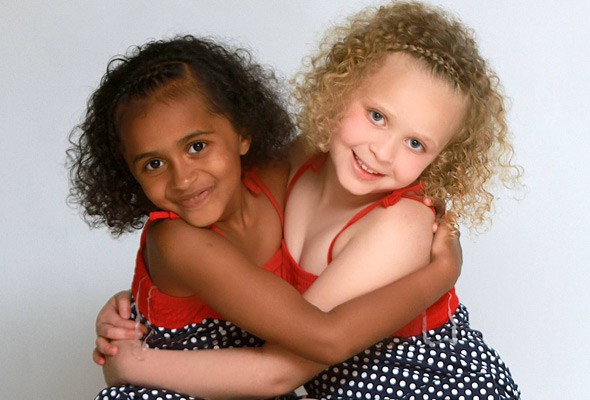
These lovely girls, Kian and Remee, are million-to-one twins born with different skin colors. The girls, whose parents are mixed-race, just celebrated their 7th birthday together. The girls? mother Kylee is quoted on Parentdish as saying, ?The twins have got such difference personalities as well as their skin colour. Remee is laid back whereas Kian is the more confident and outgoing of the pair. They both love dancing and music, but they have different groups of friends?They have never questioned their different skin colour. They know they are twins, but they never ask why they don?t look the same. They were born this way, and they have always accepted it.?

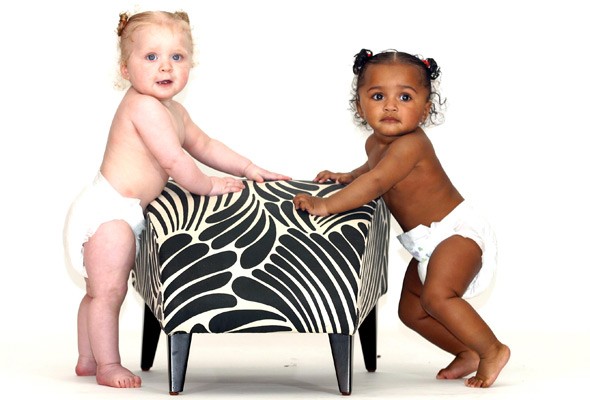
Re: Race: Black and White Twins
It can usually be difficult to tell twins apart - but not this pair. These beautiful twins share the same cheeky smile but Kian Hodgson's skin is dark and she has black hair while her sister Remee is blonde with pale skin.
The twins, who were born within a minute of each other, owe their different appearances to a one in a million combination of their parents' genes. Their mum Kylee Hodgson and dad Remi Horder both have white mothers and black fathers.
Their mother Kylee Hodgson, 25, says: "When they were born it seemed hard to believe that they were twins as they looked so different.
"I had expected that as they grew older that they may grow more similar and the difference between them would become less obvious But if anything, their skin colour is even more striking now.
"Remee is still very pale skinned and her hair has stayed a white-blond. Kian's skin has gone even darker than when she was first born. But they never question the difference between them.
They never ask me why they look so different to each other. They just accept it and they are so incredibly close.
The amazing conception happened after two eggs were fertilised at the same time in their mother Kylee's womb (as in all non-identical twins_.
The couple, who have since separated, were both stunned when they discovered Kylee was pregnant with twins. But when the twins were born in April 2005 by Caesarean, Kylee had an even bigger shock. Remee arrived first, weighing 5lb 5oz, then followed a minute later by Kian, weighing 6lb.
Kylee says: "I didn't see them at first. They were both whisked away to be checked over and then the midwife came back and placed them both in my arms. I noticed that both of them had beautiful blue eyes, but whilst Remee's hair was a blonde colour, Kian's was black and she had darker skin.
"It seemed strange, but I was feeling so ill from the Caesarean that I didn't really take it in at that stage. All that mattered was my precious daughters had arrived safely."
But the following day, Kylee mentioned the colour difference to her mother. "I said to my mother that Remee's skin was a lot lighter, and she told me that it would get darker as she got older.
I had just assumed that both our babies would have the same skin tone as me."
The doctors never explained to Kylee why the colour difference occurred.
But according to the Multiple Births Foundation, it can occur if two eggs are fertilised at the same time and one inherits the white genes and the other the black genes.
Jane Denton, from the Foundation added: "It is very rare. But it is possible for one sibling to be black and the other white if they have mixed race parents."
Both the babies were allowed home from hospital after four days and didn't need any treatment.
They then took the world by storm as one of the world's most amazing example of twins born with such a skin colour difference.
But as the years passed, Remee's skin grew lighter, whilst Kian's got darker. And while Remee's eyes stayed blue, Kian's turned brown. They are due to celebrate their seventh birthday in three weeks time.
Despite their colour differences, the girls have an incredibly strong bond between them.
Kylee, a full time mother, who lives in Dudley, West Midlands, says: "The twins have got such difference personalities as well as their skin colour. Remee is laid back whereas Kian is the more confident and outgoing of the pair. They both love dancing and music, but they have different groups of friends."
But despite their differences, the twins have an incredibly close bond. Their proud mum says: "They have never questioned their different skin colour. They know they are twins, but they never ask why they don't look the same. They were born this way, and they have always accepted it.
"They are such a perfect example of how it should be - they are not bothered about their skin colour and how different they look to each other. It isn't important to them - it's about what they are like underneath. They are the best of friends."
As a baby the white daughter looks white to me but now that she's older, she just looks like a really fair-skinned black girl to me.
Either way, this is interesting.
I see what they did, there.
I remember when they were born. I think I've heard of this happening once or twice other places.
I think they totally look like sisters, other than their eye/hair/skin color, especially in that second picture!
40/112
And here's another one and once again this looks like two black kids to me!
~~~~~~~~~~~~~~~~~
Black and white twins
James and Daniel are twins. What sets them apart is that one is white and one is black ? and the differences don't end there, as Joanna Moorhead discovers
The two teenage boys sitting on the sofa opposite are different in almost every way. On the left is James: he's black, he's gay, he's gregarious, and he's academic. He's taking three A-levels next summer, and wants to go to university. Daniel, sitting beside him, is white. He's straight, he's shy, and he didn't enjoy school at all. He left after taking GCSEs, and hopes that his next move will be an apprenticeship in engineering.
So, given that they are diametrically opposed, there is one truly surprising thing about James and Daniel. They are twins. They were born on 27 March 1993, the sons of Alyson and Errol Kelly, who live in south-east London. And from the start, it was obvious to everyone that they were the complete flipside of identical. "They were chalk and cheese, right from the word go," says Alyson. "It was hard to believe they were even brothers, let alone twins."
The boys' colour was the most obvious, and extraordinary, difference. "When James was born he was the spitting image of Errol, and I remember seeing his curly hair and thinking ? he's just like his dad. It was another two hours before Daniel was born: and what a surprise he was! He was so white and wrinkly, with this curly blond hair."
It wasn't the first time nature had shocked Alyson and Errol. Daniel and James were the family's third set of twins: Errol and Alyson each already had a set with a previous partner. Errol's first set are fraternal boys, Shane and Luke, who are 21; Alyson's are identical boys, Charles and Jordan, 20. The only singleton in the house is the couple's youngest child, and only daughter, 14-year-old Katie. "Apart from her, it's twin city," says Alyson. "At least life was made a bit easier by the fact that we always had two of everything."
But it was clear that having one black and one white twin was going to mark the family out, wherever they went. "We'd go on holiday and people would say, 'Is that one a friend you brought along?'" says Alyson. For Errol the response of strangers was harder to deal with. "People didn't believe Daniel was mine," he says. "They didn't always say anything, but I could tell it was what they were thinking."
So how does it happen that a white and a black partner ? who would usually produce, as Alyson and Errol did in their other children, black-skinned offspring ? have a child who is as white as his mum? I spoke to Dr Jim Wilson, population geneticist at Edinburgh University ? and his first question was, "What is Errol's heritage?" Errol is Jamaican ? and that, says Jim, is the basic explanation.
"It wouldn't really be possible for a black African father and a white mother to have a white child, because the African would carry only black skin gene variants in his DNA, so wouldn't have any European DNA, with white skin variants, to pass on," he explains.
"But most Caribbean people, though black-skinned, have European DNA because in the days of slavery, many plantation owners raped female slaves, and so introduced European DNA into the black gene pool.
"The thing about skin colour is that even a bit of African DNA tends to make a person's skin colour black ? so to be white, the child must have inherited more of the father's European DNA with its white skin variants. Added to the mother's European DNA, this led to a child with white skin ? while his brother, who is black-skinned, inherited more of his father's African DNA.
"The Caribbean father will have less European DNA than African DNA, so it's more likely he'll pass on African DNA ? but rarely, and I've worked it out to be around one in 500 sets of twins where there's a couple of this genetic mix, the father will pass on a lot of European DNA to one child and mostly African DNA to the other. The result will be one white child and one black."
Alyson got used to the comments and the stares, the sniggers about their parentage and the "stupid things people said" when her boys were babies; but then, when Daniel and James went to nursery aged three, the twins' skin colour plunged the family into controversy. "They were at this very politically correct nursery, and the staff told us that when Daniel drew a picture of himself, he had to make himself look black ? because he was mixed-race," says Alyson. "And I said, that's ridiculous. Why does Daniel have to draw himself as black, when a white face looks back at him in the mirror?"
After a row with the nursery staff, she gave interviews to her local paper and TV. "I kicked up a fuss, because it really bothered me," she says. "Daniel had one white parent and one black, so why couldn't he call himself white? Why does a child who is half-white and half-black have to be black? Especially when his skin colour is quite clearly white! In some ways it made me feel irrelevant ? as though my colour didn't matter. There seemed to be no right for him to be like me."
Daniel and James are listening politely, but with slight resignation, while their mum relays the story ? it is clear that, though they are aware that they are unusual, it is Alyson who is keenest on telling their tale. They don't remember the nursery incident, they say; but nod their heads as Alyson says she took them both out of it in protest.
Primary school passed without colour being an issue: but, says Alyson, everything changed when they went to secondary school. And at this point the boys, too, add their voices: because the racism they encountered there had a huge effect on them, and on what happened to them next.
It all started well, says Alyson. "The school was almost all-white, so James was unusual. But it wasn't a problem for James ? it was a problem for Daniel.
"The boys were in different classes, so for a while no one realised they were related. Then someone found out, and the story went round that this white boy, Daniel, was actually black, and the evidence was that he had a black twin brother, James, who was right here in the school. And then Daniel started being picked on and it got really ugly and racist, and there were lots of physical attacks. Daniel was only a little kid, and he was being called names and being beaten up by much older children ? it was really horrible. We even called the police."
"I was really bullied," cuts in Daniel, his face hardening at the memory. "People couldn't believe James and I were brothers, and they didn't like the fact that I looked white, but was ? as they saw it ? black."
It is interesting that it was the white twin, Daniel, and not the black twin who was on the receiving end of racism ? but, though it's counter-intuitive, Alyson agrees that it betrayed very deep-seated prejudices. "Those kids couldn't stand the fact that, as they saw it, this white kid was actually black. It was as though they wanted to punish him for daring to call himself white," she says.
While we are chatting, James and Daniel are sitting at opposite ends of the sofa; they give the impression of being polite around one another, but don't seem particularly close. As Alyson says, everything about them is chalk and cheese: even their body language is at odds ? James moves lightly and delicately, while Daniel moves in a more muscular, masculine way. But when Alyson reaches this stage of their story, you see a glimmer of that age-old solidarity where siblings who keep one another at arm's length, nonetheless pitch in when one of them is threatened.
"I started to notice how angry Daniel was getting at school, how people were provoking him and how he was getting hurt," says James. "And when he got pulled in fights, I went in too, to help him. I didn't want to see my brother being treated like that." James does not look like a kid who would end up in any fight: but, when his brother was up against it, he weighed in ? and, says Alyson, the bruises and cuts they both came home with told their own tale.
It is possible Daniel would not have liked school anyway, but being on the receiving end of racist abuse certainly did not help. "I would have left in year 7 if I could," he says. "But instead, I left in year 11 ? and it felt so good to get away." He moved to a school that was much more racially mixed, and which his older brothers had attended. "People knew I was Charles and Jordan's brother, but they were fine about it," he says.
James, meanwhile, stayed on at the old school. "It was fine in the sixth form ? things settled down, and I had never been on the receiving end of much racism," he says.
But at the same time, he was coming to terms with another major difference from his brother ? the fact that he is gay. "I knew from about the age of 15, but I kept it to myself for a while," he explains. "And then a few months ago, it just seemed like the right time to tell my family. I was most worried about my dad, about what he'd say ... but in the end he was fine about it."
Daniel, too, thought it was fine. "It wasn't as though it was a big surprise. I'd thought it for a while," he says. "But I said to him, 'If anyone starts bullying you about it, I'll be there to support you.' After all, James did that for me when I was being bullied. If anyone starts any homophobic stuff against him, I'll be there to fight them off."
Like all teenage siblings, there is plenty of joshing among the two of them. "I certainly wouldn't wear James's clothes!" says Daniel, laughing. "But if it's the other way round, he'd wear mine!"
"No I wouldn't," shoots back James. "My taste in clothes is way better than yours."
Alyson says that, initially, James's coming out was a surprise. "We were like, 'Woa!'" she says. "My big worry was that he'd think he was different, or special, because he was gay ? so we said to him: 'That's fine, it's what you are, but it doesn't make you any more special than the other children in this family.'" Errol says he was proud of his boy for being open and honest about his feelings. "It's fine; I'm glad he felt he could tell us," he says.
But Alyson does admit that, just as she once worried about racist abuse being directed at Daniel, she now worries about homophobic abuse being directed at James. "It's something you think about from time to time, but the main thing I worry about is him staying safe ? I want all of my children to be safe, obviously," she says.
These days the boys frequent very different social scenes. "A lot of my friends are lesbian or gay, and I go to gay clubs, and they aren't places where Daniel hangs out," says James. His big out-of-school interest is cheerleading ? while Daniel, whose older half-brothers Shane and Luke are both acrobats, loves tumbling. "It's something I've enjoyed for ages ? I love the thrill of it, and I love how it makes me feel," he says. After leaving school he had a spell as an acrobat on a cruise ship, which is where his older brothers also work, but he didn't stay long. "I thought it sounded brilliant, but I missed my family too much so I came home," he says. He has now applied for an apprenticeship, and hopes to make engineering his future.
Occasionally, the twins go out together for the evening. "It's good fun, because we can be drinking in a bar and someone will come along for a chat who doesn't know we're twins. And of course they never suspect and then someone else will say, 'Hey, do you know James and Daniel are brothers?'" says James. "And people never, ever believe it ? they always think it's a wind-up."
"Sometimes we even get people who say: 'I don't believe you! Prove it!'" says Daniel, laughing. "But we don't care whether they believe it or not anyway ? we know it's true."
Alyson says all she wants, like any mum, is for her boys to be happy, and to live lives free from prejudice, so that each can flourish in his own way. "Mind you," she says with a smile, "I do sometimes find myself wondering, now the children are all getting older, what the future holds. There will be another generation eventually ? who will that bring along, I wonder?
"Twins are almost a must, I'd say. But the other big thing is: how many white grandchildren will I have? And how many black?" She throws back her head and laughs, and Errol laughs with her. They're a straightforward, outspoken family, the Kellys: all they've ever wanted for their children is a fair chance in life. And if their youngest twins have made anyone think twice about their preconceptions about race and colour, they don't mind that in the least. "It's good to challenge people on race and sexuality and other issues where there's prejudice," says Alyson. "If knowing my boys encourages anyone to think a bit more deeply about how we label people, then that's just great as far as I'm concerned."
I was thinking the same. I was like, well, the fair skinned girl has features that look more black than white. The darker skinned twin looks to have more white features.
You know who looks like a black white girl to me, always has? Liya Kebede.
Zuma Zoom
40/112
Yes,I'm smiling...I'm a marathoner!
Bloggy McBloggerson
CO Nestie Award Winner-Prettiest Brain-Back to Back!
2011 Bests
5K-22:49 10K-47:38 Half Mary-1:51:50
2012 Race Report
1/1-New Year's 5K-22:11
2/11-Sweetheart Classic 4-mile-29:49
3/24-Coulee Chase 5K-21:40
5/6-Colorado Marathon-4:08:30
5/28-Bolder Boulder 10K
I'm sorry--she looks white but she's black?
Beyonce also has "white" features to me (whatever that means)
**although--** I was recently told by an African American female something hilariously true..."White people always have HUGE ears...look around you!" (We proceed to look around the group and she points out case after case of elephant ears...."Black folks always have big noses." (We look around and look for this.)
A bold stereotype? Yes. Funny? I thought so.
I'd agree about Beyonce's features as well. There was this magazine cover I remember that was Shakira but she looked like Beyonce. It was crazy.
Some features are more prominent on black people vs. white people. Broader noses vs. sharp noses, fuller lips vs thinner lips. I guess I didn't specify or differentiate in my OP.
Zuma Zoom
And it's funny because I knew exactly what you meant.
I could totally see Beyonce and Shakira..they sometimes have similar styling and they both like that wild hair look--which would make their facial features seem even more similar than they already do .
.
I thought you meant in your OP that Liya Kebede was white..and I was confused--but you didn't have to specifically differentiate I got what you meant .
.
Oh, gotcha. Yeah, she's Ethiopian. Which her features as an Ethiopian aren't too far removed for the culture. They, along with Somalians (Iman) have longer and more narrow nose bridges. Not all, but a good number.
Zuma Zoom
I don't believe this. There is no way a biracial woman could give birth to a while child. No way, no how. Homegirl must have been switched at birth.
Click me, click me!
lol'ing so hard right now
once again waiving my white girl flag
until this board i had NO idea this was possible. at all. ever. seriously, if i had seen mesh with her DD it wouldn't occur to me that she could have been her mother.
go ahead, flame away. i've learned my lesson, i swear to- um. hmm.
Skittles. You swear to skittles.
As to the first part, I always knew it was possible for a biracial parent to have a very white or even flat out white child. I did not know that it was possible for a biracial parent to have a very white or white child with bright red hair. I really didn't. But now I know why, as a very pale red head, every AA friend I've ever had has eventually said, "So... who in your family is black?" I was first asked this question in 9th grade. When I said, "Huh? I don't have any black ancestors." My friend raised her eyebrow and said, "Girl, there is no way that forehead and that hair came from a white person. No. way." I have a Tyra-like forehead (if you've ever seen her without her weave or wigs, you know what I'm describing) and very curly hair.
disagree.
she looks ethiopian to me (which she is), but she doesn't look "white," IMO.
the idea that "black" = broad nose, kinky hair, full lips, round eyes, etc. is laughable (not saying you think this sm, but i know a lot of people think this). black people, like others, are very diverse. people need to get out more often.
it's also not surprising that two half black/half white people would have 1 kid who is light and one who is darker. hello, the parents are mixed!
Except they aren't American at all...so...notsomuch. I won't even touch the last bit of stupidity you threw in there.
Also I totally think Liya Kebede looks Ethiopian, but I kind of understand what you guys are saying. Ethiopians more commonly have facial features that are considered "white" in our culture. Maybe because most Africans in this country until very recently came from the opposite side of the continent.
She looks a lot like an albino black girl I knew from an early job.
And that was a weird experience in itself. The girl would only talk to the other black people in the office. It would always be about whatever black musician or comedian was hot at the time....so it seemed like this white girl was being a real ass by patronizing the black folk with "Hey, did you see Damon Wayans (or whoever was big int he early 90s) last night. I love him!" Sort of like Archie Bunker going up to a black person and saying 'Hey, that Sammy Davis is quite an entertainer, he's fly', you know? It was embarrassing, this blonde blue eyed girl talking loads of stereotypical black slang all the time.
So, it was kind of a shock to go from thinking of her as a racist white, to a racist black - due to her pointed snubbing of white people - when I found out she was actually 100% black. I think her coldness was probably due to an insecurity over being accepted as black, not mistaken for white. Instead of a white girl trying too hard, she was a black girl but still trying too hard.
This is another family who had two sets of twin girls.
http://www.thesun.co.uk/sol/homepage/news/article2082429.ece
I grew up down the road from two boys who'd be considered 100% black- both parents, and both sets of grandparents were AA. BOTH of them had BRIGHT red hair. They were both fairly dark skinned, and in all other ways looked "black"- except for their hair color. We went through pre-school through high school together, and my mom was friends with their mom, so eventually I asked- apparently, a great grandparent on one side was a white, redhaired man-- and boom, two generations later is the pay off.
That said, in my own little sheltered world, I knew hair color could be wonky amongst generations for all people- I didn't realize how often parents would birth a child with darker skin than the mix of their parents. I guess I thought that biracial kids always were lighter, and the next generation would be even lighter? I don't know. I stopped thinking that around age 15 or so, so my logic is a little fuzzy at this point. It just goes to say that Pinky and Mesh's DD wouldn't have surprised me- but Pete might have. (Like I said, I have no idea why I used to think that. I'm a weirdo.)
Anything you can achieve through hard work, you could also just buy.
I freaking love genetics. I think this story is really interesting, and my husband is all, "OMG, this is not amazing. This is just biology. This makes sense!"
I want to see a million punnett squares of these girls! You always learn that darker is more dominant, so I'd have expected the girls to even be born light-ish but darken.
They are both super cute.
There's a poster on the Parenting board on the bump who has boy/girl twins. The boy is very light (blondish hair, blue eyes) and the girl is what you'd consider black, similar to these twins.
I, too, am fascinated by genetics.
Shhhh! If folks start believing it I might get away with kidnapping the ginger girl!
I couldn't agree more. I love me some punnett squares.