


Our tech team has launched updates to The Nest today. As a result of these updates, members of the Nest Community will need to change their password in order to continue participating in the community. In addition, The Nest community member's avatars will be replaced with generic default avatars. If you wish to revert to your original avatar, you will need to re-upload it via The Nest.
If you have questions about this, please email help@theknot.com.
Thank you.
Note: This only affects The Nest's community members and will not affect members on The Bump or The Knot.
Pressure-cooker kindergarten
Pressure-cooker kindergarten
A new emphasis on testing and test preparation -- brought on by politicians, not early education experts -- is hurting the youngest students.
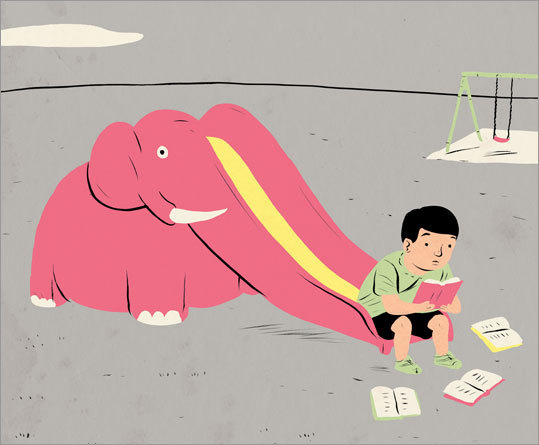 (Illustrations by Paul Blow)
 To:
To:

Sending your article
Your article has been sent.

- |
Christine Gerzon is the epitome of a kindergarten teacher: warm and wise, quick to get down on her knees to wipe a tear or bandage a boo-boo. She can rhapsodize for hours about a single leaf and philosophize convincingly about the pedagogical uses of papier-mache. ?I teach because it?s my calling,? she says. ?It?s my life purpose.?
 |
Discuss |
| COMMENTS (186) |

Yet two years ago, after 38 years as an educator, she threw up her hands and retired. (Her last job was at the Harrington School in Lexington.) She couldn?t stand the pressure.
Pressure? This is kindergarten, the happy land of building blocks and singalongs. But increasingly in schools across Massachusetts and the United States, little children are being asked to perform academic tasks, including test taking, that early childhood researchers agree are developmentally inappropriate, even potentially damaging. If children don?t meet certain requirements, they are deemed ?not proficient.? Frequently, children are screened for ?kindergarten readiness? even before school begins, and some are labeled inadequate before they walk through the door.
This is a troubling trend to an experienced educator like Gerzon, who knows how much a child can soak up in the right environment. After years of study and practice, she?ll tell you that 5-year-olds don?t learn by listening to a rote lesson, their bottoms on their chairs. They learn through experience. They learn through play. Yet there is a growing disconnect between what the research says is best for children -- a classroom free of pressure -- and what?s actually going on in schools.
Take the example of a girl who was barely 5 when she entered Gerzon?s classroom. She didn?t know her ABCs, but one day in class she made up a song and taught it to the other children. But because of new requirements, ?I had to send a letter to her parents saying that [she] is not proficient,? says Gerzon. ?You tell me that [she] is not proficient in language skills!? The Concord resident, who usually exudes a gentle presence, bristles. ?It?s destructive, even abusive. That?s a pretty strong word, but what do you call it when you take a group of children and you force them to do something that they are not developmentally ready to do? What do you call that? It?s abusive.?
Psychologist and early childhood expert David Elkind, author of The Hurried Child and The Power of Play, echoes Gerzon. When children are required to do academics too early, he says, they get the message that they are failures. ?We are sending too many children to school to learn that they are dumb,? says Elkind, a professor emeritus at Tufts University. ?They are not dumb. They are just not there developmentally.?
* * *
It?s been more than two decades since Robert Fulghum published the oft-quoted (and oft-mocked) essay ?All I Really Need to Know I Learned in Kindergarten.? The piece describes a bucolic world of wonder, a place for cookies and afternoon naps.Continued...

Re: Pressure-cooker kindergarten
Between insane politicians and helicopter parents, I swear this entire generation of kids is going to spend their adult lives in therapy over the trauma of their early education experience.
My friend lives just outside of Palo Alto. That whole area is full of pressure because I imagine many children there are expected to found a company someday. I feel extremely anxious being there as an adult. And as a parent, forget it. Within a day I feel like a complete failure because my kid isn't on her fourth language and doing calculus and taking tennis from a pro. My friend talks about maintaining the balance between excellence and normalcy.
When I read about the preschools there, as fabulous as they sound, there's a part of me that is thankful my kid goes to regular preschool where no one expects the world of her at age 4.After the last round of "what is happening to our kindergarten curriculum" on p&ce I frantically researched what our actual school system was like. Thankfully others were able to talk me off the ledge and I feel better.
But I will say I can't imagine parenting in a way that prepares young children for the pressure cooker so soon. It is much more entertaining/satisfying/fullfilling to let them be little kids. Like the little kid in the article that made up a little song. LOVE THAT. I would find a child that can do that a million times smarter than a child who can just articulate the ABCs. Because creativity eventually translates into some pretty cool stuff when it comes to classroom performance. As a parent I would rather see it all go down that way for my child. I wish our school system as a whole felt that way as well.
I read an interesting article recently that I intended to C&P here but don't think I ever did. The focus of the article was whether the American public school system can churn out entrepreneurs and the meat of the argument was that one of the very best ways for a child to learn to think outside the box is to be allowed to fail. The argument was made that our current educational system does not encourage failure on any level and that ultimately this stifles learning and creativity.
ETA: By "fail" I do not mean receive an F in class, obviously, but to not get things right the first time every time when learning something new. The idea is that failure teaches you to think creatively about how to work around what caused your initial failure.
I haven't read the article but I really truly believe this. It seems the time we allow our kids to be creative beings is shrinking. Just think about kids building a fort. Think of the lessons that are gained in that process. You try something, it fails, you rethink try again, find new supplies, and eventually suceed. This is sort of a dumb example but I do not think our kids are being allowed this process anymore. Instead it is lessons, lessons, lessons, go home and have more lessons and practice. This is not the way to make creativity flourish. And if they don't learn it at a young age how will they ever be able to grasp the concept?
eddy - I am a board member of the parents' organization at my daughter's elementary school and just yesterday we were having a meeting with some administration folks who were discussing this matter. Every year the 1st and 7th graders have to collaborate on a problem-solving project and every year the 1st graders come up with solutions more quickly and that are of better quality than the 7th graders because they don't know any better than to think outside the box.
That is interesting and disturbing!
When I was in school the TAG kids (talented and gifted) were picked because of their creativity skills. They were the kids who were always doing really intelligent creative things like making spaceships out of kitchen utensils. And it was assumed that if they had that level of creativity they would be the students who becaming the so called academic leaders of the class.
Now it is my understanding that TAG students are identified due to aptitude in testing or other measures. I just find the shift curious.
This is such an important point. In our rush to compete with China and Singapore over who can be the best at math and science, we've forgotten about our competitive advantage over those countries - namely, creativity, independence, entrepreneurial thinking. We think that the more we can test, the more correct answers we can cram down our students' throats at a time, the better. And learning just doesn't work that way.
I think it's sad that children's natural love of learning and innate curiosity and creativity is being stomped upon earlier and earlier. No wonder kids hate school so much - we're doing our best to make learning as miserable an experience as possible.
I've also been reading Quiet: The Power of Introverts in a World That Can't Stop Talking which I'm loving, and according to her we are also doing a disservice trying to make every kid into and extrovert/leader. Some of the most successful entrepreneurs are introverts (people who work better alone with little outside stimulation) and all the push for people to brainstorm together and work in groups and be vocal and "rah-rah" all the time actually makes a lot of people less productive and creative. Not everyone is an extrovert or a leader, and the world could not run with only that one type.
That book I just linked above talks a lot about China as well. Basically how it is possible that a lot of the reason they are so successful math and science wise is because China tends to be more introverted culturally. I'm in the middle of the chapter so I can't do justice, but it has to do with how they teach and study, how they interact with each other in school... I'll come back after I've read it.
I agree I have to physically restrain myself or focus on something else to not step in during these situations. It is hard. I have started turning the tv on when we do puzzles for this reason. Or I think an even more difficult skill is pushing them when they want to give up. So if J is all "I can't do it." My natural reaction is to want to fix it for him. It is much harder to say "No you an do it. Think again." And then deal with the backlash of 4 year over reaction.
I don't mean to throw water on the fire (or salt in the wound)... but who thinks it's the job of the public school system to "churn out entrepreneurs"?
My general sense is that there can only be so many leaders, creatives, entrepreneurs... and that the public school system's job is to make sure that there are sufficient numbers of (for want of a better word) "cogs" - people who aren't leaders, aren't trying to be artists, aren't trying to strike out on their own - people who go to work, collect a paycheck, and go home, like the vast majority of people do.
I am the 99%.
...and as to the OP (I haven't read the whole piece yet, just what was c&p'ed)... IMHO, redshirting has a huge amount to do with this.
The more you have seven year olds in Kindergarten, the more kindergarten turns into something with expectations appropriate to seven year olds, KWIM?
I am the 99%.
We're (meaning me and the little one) are participants in an early childhood study. Part of the observation portion is to give Nae objects and see how quickly she learns to solve the problem. One item was a box that had a rubber duck in it, but the bottom and one side was open. The interviewer placed the duck in the box, and set it on the table. The interviewer held the box down so that Nae could only access the duck through the open side. It KILLED me watching her get frustrated and trying to figure out how to get the duck out.
But that exercise was important to me. It reinforced that you have to allow kids the ability to think out the problem for themselves. I find myself telling T to think through a question before asking me so that she can get the answer herself. Once she figures it out, she can ask me if it's right or wrong.
I overtly try not to step in, and to make her/them figure it out on their own. It's rough though.
I'm also trying not to compliment innate characteristics, but instead compliment work, effort, trying... like "you did great! You're so smart!" is a no, while "You did great! You must have worked really hard on that!" is a yes. It's difficult, though.
I am the 99%.
It's not the school system, it's the parents. The parents want academics, they want wildly inappropriate activities like worksheets, they want their kids to learn letters rather than reading skills like story telling and predicting what will happen next. They want it, and they choose and send their kids to the preschools that offer it. You see it in threads on here, and it's true IRL, too. If your kid is in a play based preschool ask the person who does parent tours what kinds of things people ask.
Testing? Preparation? In kindergarten?
I remember making those hand turkeys and having stories.
It absolutely does... my state just pushed back the start date for K from Sept 30 to Aug 1 but didn't do anything to stop the redshirting which is where the issue is... and parent red shirt partly because they've been told K is the old 1st grade
Above Us Only Sky
I remember nap time.
It led to an outbreak of head lice
To be fair, the point of the article wasn't that schools need to mold every other child into an entrepreneur. It was about the turn away from creative thinking because of the various issues raised in the OP and whether this change in our educational system reduces the likelihood that there will be another, say, Steve Jobs.
As TTT said, America's strength is in its creativity. We have lost our manufacturing mojo, and I don't care what Romney or Obama say, it's not coming back. The flip side to this is that while China, et al., make a lot of products, they tend to be products created by Americans. That's our primary strength in the world economy. We all fret about offshoring work to lower-paid individuals, but the so-called "low productivity" worker that manages to keep a job here in the States is going to be pushed out by computers anyway.
I agree that many people aren't destined to be leaders per se, which speaks to what cee-jay mentioned. Nevertheless, I don't think that means we ought not to care about stifling a child's creativity beginning at age 5. Simply because a child may not wind up being a billionaire entrepreneur doesn't mean we shouldn't give her the tools.
Hear, hear!
..... says this humble kindergarten teacher.
It's ridiculous. But the stupid politicians and policy makers don't listen to us, because hey, what do I know? It's not like I have a masters degree in early education and developmental psychology! Oh, wait. Yes, I do.
This really speaks to me. I do well in a variety of situations, but I am just not a leader, and I agree that the pressure to brainstorm and do everything in groups is quite annoying. I would hate being in today's school system. I always give my kids the choice to work alone or in a group, and 6 or 7 choose to work alone.
On the original subject, I agree with all the above posts. My MIL teaches kindergarten and is retiring next year. She feels that there is too much pressure to churn out good test-takers. It's ridiculous. Kindergarten has gotten way away from what it used to be. My MIL had to read a story ONCE to kids and have them answer questions about it. It was a test of great importance supposedly. She had kids crying, shutting down, etc. It's so dumb. There's too much emphasis on it. I am so stressed about the OAA next week that I have had stress headaches, dizziness, and other really bad symptoms for about two weeks, all for a 2.5 hour test on one day... that means all according to the state. I can't imagine how nervous I will be next year when we're linked with the kids.
It's even worse with littler kids, of course.
I totally agree with this. I value entrepreneurs but could not be one myself, and I'm alright with that. I have a different skill set.
I even joke with my husband that my seventh grade colleague is the team leader and I'm the #1 Lackey. I'm the one whom she goes to with her "grunt work" when she needs someone reliable, like for helping serve detentions, take minutes at the team meetings, and so forth.
I agree with this actually. Just look at the high expectations people have of day care centers.
Click me, click me!
It's funny that people bring up the "allowed to fail" thing because I actually see that as one of the most damaging things about modern parenting and life for children, beyond just the high pressure kindergarten. It's not just being allowed to fail in school, it's being allowed to fail in general that's disappearing because parents can't bear to see their child not succeed or hurt emotionally (let alone physically). And it's not just damaging as far as stifling creativity- criticism and failure are two huge things that are absolutely essential for children to develop healthy self-esteem and I think we're seeing a whole generation that's going to be listless as adults because they're not used to regularly falling on their asses as it were, because adults are so quick to intervene and "help". So much current popular parenting theory is geared towards children's self esteem but very little of the time does it focus on coping skills, tenaciousness, etc. It's always making sure you don't "hurt" the kid in the first place, not on recovering, and it's just completely unrealistic for how the world actually works (and how we function in it).
Anyway, I also agree with HAB and others who point out that things are this way because it's what most parents want. It's probably alarmist for me to start pointing fingers at obnoxious shii!t like baby einstein but the educational climate is the way it is because that's what the demand is for, especially for upper middle class people who are college educated and have high expectations for their kids to be even smarter than them. The sad thing is that you can teach singapore math and encourage science exploration without raising the stakes or pressure, but it comes down to the fact that parents want to compete and don't care that it's hurting their kids in the crossfire as long as they're "winning" achievement wise.
Yep. Worksheet at a young age make me stabity ( sorry mexi)
i understand all of this, but then it gets me right back to the question, what should i be doing?! i read to them, we play, they are in activities with other kids, but i'd be lying if i said we've never done a trace your letters or match the baby animal with the momma animal worksheets. i want my kids to be kids, but i also want them to be somewhat prepared for going to school bc if they're not i'm afriad of them getting labeled (like i did when i was in school) as having delays or what have you, and then trying to overcome that as well.